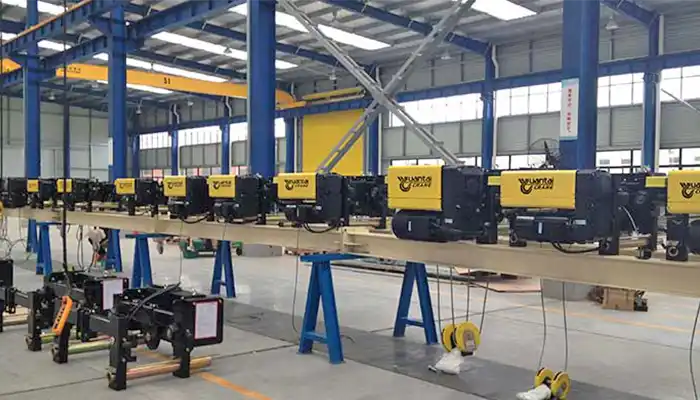
Protect PV Modules with Anti-Sway & Soft-Load Hoists
menu_open
Content Quick Link
Protecting PV Modules with Anti-Sway and Soft-Load Hoists: A Buyer’s Guide
Most Important Takeaway
PV module damage during lifting is rarely caused by overload—it is caused by uncontrolled motion.
Anti-sway hoists and soft-load (soft-start / soft-stop) control systems directly address the root causes of broken glass, micro-cracks, frame distortion, and unsafe handling in PV module production and logistics.
Key Takeaways
- Anti-sway hoists significantly reduce lateral movement and load swing during crane travel.
- Soft-load hoists minimize shock loads that damage fragile PV modules.
- Proper crane attachments and lifting fixtures are as critical as the hoist itself.
- These technologies improve module protection, operator safety, and throughput stability.
- For high-volume PV handling, investing in motion control reduces long-term scrap and warranty risks.
Why PV Modules Cannot Be Lifted Like Ordinary Industrial Loads
PV modules require specialized handling because their lightweight, wide, and fragile structure reacts differently from standard industrial loads.
PV Modules Look Rigid, but They React Like Fragile Panels
A finished PV module appears solid once it leaves the production line. In reality, during lifting and movement, it behaves more like a large glass panel than a mechanical part. The structure is light, wide, and sensitive to uneven force, making it vulnerable when handled with standard overhead crane systems.
In many solar plants, damage does not come from overload or accidents. It comes from normal daily lifting that is simply not controlled well enough.
Small Motions Create Real Damage
During overhead crane travel, slight movements add up quickly. A small swing angle, a fast start, or a sudden stop can introduce stress that the module cannot absorb.
Typical damage caused by uncontrolled crane motion includes:
- Cell micro-cracks, which often pass visual inspection but fail later during EL testing or field operation.
- Glass edge damage, especially when the module contacts fixtures or adjacent loads.
- Frame distortion, which affects mounting accuracy and sealing performance.
- Quality rejections, leading to scrap, rework, and delayed shipments.
These issues are common in facilities using basic hoists with fixed-speed or rough motion control.
Why Standard Hoists Fall Short in PV Module Handling
Most electric hoists are designed around robust industrial goods. Steel plates, motors, pallets, or containers can tolerate swing and impact. Solar panels cannot.
Common limitations of standard hoists include:
- Abrupt start and stop behavior from simple control systems.
- No built-in sway control during cross or long travel.
- Load movement that depends entirely on operator skill.
- Poor stability over long spans or at higher travel speeds.
For fragile load lifting, these weaknesses show up quickly.
The Real Requirement: Controlled Motion, Not Higher Capacity
When specifying overhead crane safety solutions for PV module handling, capacity is rarely the problem. A 1–2 ton hoist is often more than enough. The real requirement is smooth, predictable, and repeatable movement.
Specialized lifting solutions address this by:
- Reducing swing at the source.
- Limiting shock during lifting and lowering.
- Keeping loads stable during travel and positioning.
For solar panel damage prevention, cranes must move in a way that matches the product, not the other way around. This is why PV module handling requires lifting systems designed specifically for fragile loads, not repurposed standard equipment.
Common Lifting Risks in PV Module Production and Warehousing
Identifying typical lifting risks in PV module factories and warehouses helps prevent micro-damage, maintain quality, and protect operators.
Where Things Go Wrong in Daily Handling Operations
In PV module factories and warehouses, lifting problems rarely happen during exceptional events. They happen during normal work. Repeated moves, tight schedules, and routine transfers between stations gradually expose weaknesses in crane control and lifting setup.
Most damage and safety risks can be traced back to a few predictable lifting behaviors.
Load Swing During Cross and Long Travel
When an overhead crane accelerates or changes direction, the suspended load naturally reacts. With PV modules, even a small sway creates uneven stress across the glass surface and frame.
Typical causes include:
- Long travel distances across wide workshops
- High trolley speeds without sway control
- Wind influence in semi-open or roof-ventilated buildings
Without crane sway control for solar panels, operators often slow down excessively or make manual corrections, both of which reduce efficiency and increase risk.
Sudden Starts and Stops That Create Impact Forces
Basic hoists respond immediately to pendant commands. A quick press on the button can translate into a sharp mechanical response.
This leads to:
- Shock loads during lifting and lowering
- Load bounce at pickup and set-down points
- Stress concentration at lifting fixtures
In overhead crane systems for PV module handling, these impact forces are a frequent cause of hidden micro-damage that only appears later in testing or field use.
Unbalanced Lifting Points and Unstable Attachments
PV modules rely on even load distribution. If lifting points are poorly positioned or attachments are not designed for panel geometry, the risk increases.
Common issues include:
- Narrow lifting spans that twist the frame
- Attachments that allow tilting during travel
- Incompatible fixtures used for different module sizes
Preventing solar module damage during lifting requires attachments that work together with stable crane motion, not against it.
Operator Overcorrection Due to Poor Load Visibility
When operators cannot clearly see load movement, they often compensate by stopping, reversing, or adjusting travel frequently.
This behavior can result in:
- Excessive start-stop cycles
- Increased swing instead of reduced swing
- Higher operator fatigue and stress
In busy production or warehousing environments, relying solely on operator skill is not a reliable safety strategy.
Why These Risks Matter
Each of these lifting risks affects more than just handling speed. They directly impact:
- PV module quality and rejection rates
- Workplace safety and near-miss incidents
- Production flow consistency
For both product integrity and worker safety, understanding and controlling these risks is a basic requirement when selecting an overhead crane for PV module handling.
Anti-Sway Hoists: Controlling Load Movement at the Source
Anti-sway hoists prevent PV module damage by controlling load motion at its source, improving safety and positioning accuracy.
What Is an Anti-Sway Hoist?
An anti-sway hoist is designed to control load movement before it becomes a problem. Instead of reacting after the load starts swinging, the system limits pendulum motion during crane acceleration, travel, and deceleration.
In practical terms, anti-sway control can be achieved in several ways:
- Mechanical damping, where structural or trolley design helps reduce natural swing
- VFD-based motion control, using controlled acceleration and deceleration curves
- Sensor-based or intelligent systems, which detect load movement and automatically adjust crane speed
In an overhead crane for PV module handling, anti-sway is not about complex automation. It is about reducing unnecessary movement and keeping the load steady as it travels.
Why Anti-Sway Matters in PV Module Handling
PV modules respond poorly to swinging loads. When a suspended panel starts to move laterally, stress builds unevenly across glass and frame components. Anti-sway hoists address this issue at its source.
Key benefits include:
- Stable load positioning during movement, even over long travel distances
- Reduced collision risk in narrow aisles, assembly lines, and inspection areas
- Improved placement accuracy when setting modules onto conveyors, pallets, or storage racks
- Lower dependence on operator skill, especially for new or rotating staff
With sway control in place, operators do not need to “fight” the load. The crane moves more predictably, and positioning becomes smoother and repeatable.
Practical Impact on Safety and Production
From a safety perspective, an anti-sway crane reduces sudden load shifts that can surprise operators or nearby workers. From a production standpoint, it allows slightly higher travel speeds without increasing risk, which helps maintain steady throughput.
In facilities using precision lifting equipment for solar panels, buyers often find that anti-sway control reduces both visible damage and hidden defects caused by repeated minor impacts.
Where Anti-Sway Delivers the Most Value
Anti-sway hoists are particularly effective in:
- Long-span workshops where swing amplification is common
- High-frequency PV module transfer stations
- Areas with limited clearance or close-proximity equipment
As part of an intelligent crane system, anti-sway functionality turns overhead lifting into a controlled, predictable process rather than an operator-dependent task.
Soft-Load Hoists: Eliminating Shock and Impact Forces
Soft-load hoists protect PV modules by controlling acceleration and deceleration, reducing shock, stress, and impact during lifting.
What Does “Soft-Load” Mean in Real Operations?
A soft-load hoist controls how the load starts, moves, and stops. Instead of reacting instantly to an on/off command, the hoist accelerates and decelerates gradually. This behavior is typically achieved through variable frequency drives (VFDs) integrated into the hoisting, trolley, and travel motions.
In daily use, soft-load control shows up as:
- Smooth pickup when the module leaves the ground
- Controlled lifting speed that ramps up, not jumps
- Gentle lowering without sudden rope slack or hard landing
For fragile load lifting, this difference is easy to feel and easy to see.
Why Soft-Load Control Matters for Solar Panels
PV modules are sensitive to dynamic forces. Even if the static weight is low, sudden movement can create internal stress that leads to damage later in the process.
Soft-load hoists help prevent this by addressing the most common causes of impact.
They:
- Prevent sudden tensile stress on glass and frames, especially at initial lift
- Reduce load bounce during hoisting and lowering, keeping the module stable
- Protect lifting fixtures, slings, and suction devices from shock loading
- Extend crane component life by reducing wear on wire ropes and brakes
In a VFD hoist for PV modules, these benefits appear consistently, shift after shift.
Common Problems with Non–Soft-Load Hoists
Without soft-start and soft-stop control, operators often experience:
- Jerking motion when lifting begins
- Sudden stop when releasing the pendant button
- Rope slack followed by impact on re-lift
These behaviors are acceptable for general cargo, but not for shock-free lifting of solar panels.
Production and Maintenance Benefits
Beyond module protection, soft-load control also improves operational stability:
- Fewer rejected modules due to handling damage
- Less frequent fixture adjustment and replacement
- Smoother handover to conveyors, racks, or automated systems
For buyers specifying a soft start hoist for fragile loads, soft-load control is not an extra feature. It is a basic requirement for safe, repeatable PV module handling.
Crane Attachments Designed for PV Modules
Proper lifting attachments are critical for translating anti-sway and soft-load hoist benefits into safe PV module handling.
Why Lifting Attachments Matter
Even the best anti-sway and soft-load hoists cannot fully protect PV modules if the attachment isn't suited to the load. The attachment is the interface between the crane and the module, and it determines how forces are distributed across the glass and frame. Choosing the right attachment ensures that controlled hoist movements actually translate into safe handling.
Common Attachments for PV Module Handling
Depending on the production process, workshop layout, and module design, the most common attachments include:
- Vacuum lifters – Ideal for flat, sealed module surfaces. They reduce point pressure and hold the panel evenly across its surface.
- Lightweight spreader beams – Used for larger modules or bundles, they maintain balance and prevent tilting during travel.
- Custom module clamps or frame-support fixtures – Designed for unique frame shapes or special handling requirements, these clamps distribute load evenly and work with existing hoist control systems.
Buyer Considerations
When evaluating crane attachments, buyers should focus on:
- Even load distribution across the module surface – Avoids stress points that can crack glass or distort frames.
- Compatibility with anti-sway and soft-load systems – Attachments must work with controlled motion; otherwise, the benefits of the hoist are lost.
- Certification and safety factor compliance – Check ISO or CE certification and verify the safety factor of lifting points, especially for high-cycle production.
Attachments should be matched not just to the module, but to the lifting workflow. For example, vacuum lifters are excellent for individual modules, but spreader beams may be needed for multi-module transport. Integration with anti-sway hoists ensures smooth movement and reduces operator intervention.
Safety Features Procurement Engineers Should Specify
Why Safety Features Are Essential
When handling PV modules, safety is more than just protecting workers—it’s about protecting the product. Even small mistakes or equipment shortcomings can lead to glass cracks, frame damage, or costly production delays. For procurement engineers, specifying the right safety features ensures that the crane system can handle fragile loads reliably and consistently.
Key Safety Features to Include
When sourcing hoists and overhead cranes for PV module handling, the following features are critical:
- Variable Frequency Drives (VFD) – Allow smooth start and stop, reducing shock and minimizing load sway.
- Anti-sway or sway-reduction functionality – Keeps panels stable during travel, reducing collisions and stress.
- Load monitoring and overload protection – Ensures the hoist never lifts beyond its rated capacity, preventing structural or module damage.
- Controlled braking and emergency stop systems – Provides predictable stops and added operator safety in case of unexpected events.
- Compatibility with plant safety standards – Meets local regulations and integrates with existing safety systems in the production facility.
These features are not “nice-to-have” extras. In environments where PV modules are moved daily, they are risk-control tools. By specifying them in RFQs and technical requirements, procurement engineers can reduce hidden damage, minimize downtime, and protect both workers and modules.
Operational Benefits for Production Planning
Why Production Planning Should Care
Anti-sway and soft-load hoists do more than protect PV modules—they make handling predictable, consistent, and easier to integrate into the overall production workflow. For production planners, these benefits directly affect output, efficiency, and staffing requirements.
Key Operational Benefits
Using controlled hoists and proper lifting attachments results in measurable improvements on the shop floor:
- Lower module breakage and rejection rates – Fewer damaged panels means less scrap and rework, improving overall yield.
- More consistent handling cycles – Smooth, predictable movements help maintain steady workflow timing across production lines.
- Reduced operator fatigue and retraining – Easier-to-control hoists reduce physical strain and shorten the learning curve for new or temporary staff.
- Improved line uptime and safety performance – Less downtime from handling errors and fewer near-miss incidents keeps production running smoothly.
- Easier scaling as module sizes increase – Larger panels or multi-module bundles can be handled safely without redesigning workflow or attachments.
From a production planning standpoint, specifying anti-sway and soft-load systems is an investment in reliable throughput, safer operations, and long-term production flexibility. They allow planners to focus on output and scheduling rather than constantly managing handling errors.
Buyer Checklist Before Issuing an RFQ
Preparing for a Smooth Procurement Process
Before sending out a request for quotation (RFQ), procurement engineers should ensure that all critical requirements for PV module handling are clearly defined. This reduces the risk of misquotes, hidden costs, or equipment that doesn't meet operational needs.
Essential Checklist Items
- Confirm PV module dimensions, weight, and lifting frequency – Provides the baseline for hoist capacity, attachment selection, and duty cycle rating.
- Specify anti-sway and soft-load control in technical requirements – Ensures the crane system can handle modules safely and reduces hidden damage.
- Match attachments to module design and handling flow – Aligns lifting fixtures with module type, travel path, and workflow requirements.
- Evaluate supplier experience with PV or fragile-load projects – Look for proven case studies or references to avoid inexperienced vendors.
- Assess total cost of ownership, not just equipment price – Factor in maintenance, downtime, energy consumption, and long-term module protection benefits.

FAQ: Questions Solved in This Guide
Answers to common PV module lifting and handling concerns for outdoor gantry cranes.
Q1: Why do PV modules get damaged during crane lifting and transfer?
PV modules are lightweight but fragile. Even small swings, sudden starts or stops, and uneven lifting points can create micro-cracks in cells, glass edge chipping, or frame deformation. Standard hoists without motion control often fail to prevent these stresses.
Q2: How does anti-sway technology protect fragile solar panels?
Anti-sway hoists limit pendulum motion during crane travel, keeping the module steady. This reduces lateral stress, prevents collisions in tight aisles, improves placement accuracy, and lowers dependency on operator skill.
Q3: What is a soft-load hoist, and why is it essential for PV module handling?
A soft-load hoist uses controlled acceleration and deceleration (soft-start and soft-stop) through VFD systems to eliminate shock forces. This protects glass and frames from sudden tensile stress, reduces load bounce, and extends the life of lifting fixtures and crane components.
Q4: Which crane attachments are best for lifting PV modules safely?
The choice depends on module type and handling flow:
- Vacuum lifters for flat, sealed surfaces
- Lightweight spreader beams for larger modules or bundles
- Custom module clamps or frame-support fixtures for unique frame designs
Attachments must ensure even load distribution and be compatible with anti-sway and soft-load hoists.
Q5: What specifications should procurement engineers include in RFQs?
- Module dimensions, weight, and lifting frequency
- Anti-sway and soft-load functionality
- Attachment type and compatibility with module design
- Supplier experience with PV or fragile loads
- Total cost of ownership, not just initial price
Q6: How do these features improve production efficiency and operational safety?
Anti-sway and soft-load hoists reduce module damage, lower rejection rates, and enable smoother handling cycles. They reduce operator fatigue, improve line uptime, and provide safer, predictable motion, which allows production planners to maintain steady throughput and scale operations efficiently.
Conclusion: Protecting PV Modules Starts with Motion Control
Anti-sway and soft-load hoists are not optional upgrades for PV manufacturing and logistics operations—they are essential safeguards. By controlling load movement and reducing dynamic forces, buyers can protect high-value PV modules, improve workplace safety, and stabilize production efficiency over the long term.
For procurement engineers and production planners, the right hoist selection turns lifting equipment from a risk factor into a production asset.

Article by Bella ,who has been in the hoist and crane field since 2016. Bella provides overhead crane & gantry crane consultation services for clients who need a customized overhead travelling crane solution.Contact her to get free consultation.